Query by Example ( cont. )
To illustrate the notion of CST object, consider an example of a two-dimensional desk "my-desk" depicted in the figure below as the larger rectangle.
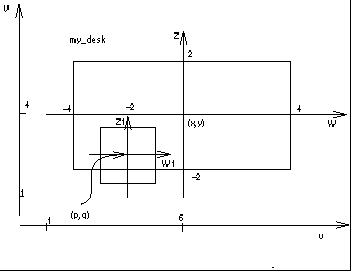
The smaller rectangle depicts the desk's drawer, which may open, i.e. move relatively to the desk. Similarly, the desk may be moved in the room. In the figure, the extent of my-desk is the set of points { (w,z) | (-4 £ w £ 4) Ù(-2 £ z £ 2) } which is captured as the CST object (-4 £ w £ 4) Ù(-2 £ z £ 2) in free variables w,z, i.e., of the class CST(w,z). Note that, conceptually, CST objects are viewed in CCUBE as symbolic constraint expressions. Thus, the names of (free) variables are meaningful and are part of CST objects.
Similarly to the desk's extent, the extent of the desk's drawer in the drawer's coordinates can be described by the CST object (-1 £ w1 £ 1) Ù(-1 £ z1 £ 1). The possible locations (p,q) of the drawer's center in the desk's coordinates can be described by p = -2 Ù-3 £ q £ -1; note that the horizontal component of the center, p, equals to a constant since the drawer in the example cannot move left or right; note also that the vertical component, q, is between -3, when the drawer is fully open, and -1 when it is closed. Also, the translation between the desk's w,z and the room's u,v systems of coordinates can be captured by the constraint u = x + w Ùv = y + z, meaning that if the desk's center is at (x,y), then a point (w,z) in desk's coordinates is (u,v) in the global room's coordinates.